الفن العربي means “Arabic Art”. It is the name of ARABART, his engine for writing Arabic.
Yasser Awad taught a PC to write Arabic.
Port Said, Egypt, 1991. This is his code, ported line by line, drawing every letter you type.
- Arabic letters join their neighbors. Pull a word apart and each letter stands alone.
- So one letter needs up to four shapes: alone, at the start, in the middle and at the end. Here is ع. He drew every shape by hand, for five fonts.
- His engine looks at each pair of neighbors and gives every letter its shape. The whole rule is 13 instructions of assembly. In JavaScript it is one line.
- His name, drawn by his own engine: ياسر عوض, Yasser Awad. Port Said, 1991.
- Fifteen of his programs survive, and every one runs in your browser on a real DOS emulator. Pick one.
Fifteen programs from Port Said
1991 to 1993: 282,675 bytes of his code in all. Pick one and press Run.
- ARABART Demo199118,129
- ARABART Editor199117,492
- Arabic Commercial19914,864
- Arabic Basmallah19913,739
- Port Said IT Department19911,672
- TAHER19912,050
- Formula Solver19923,546
- WINKEY19924,220
- Digi-Test199379,358
- Text Editor Sample GUI199336,526
- Text Editor Demo199320,565
- KVC Kemyam Virus Capture199311,000
- Kemyam Group Names199313,090
- Port Said Computer Systems199318,715
- The Brave Sun199347,709
C:\ARABART\DEMO.EXE
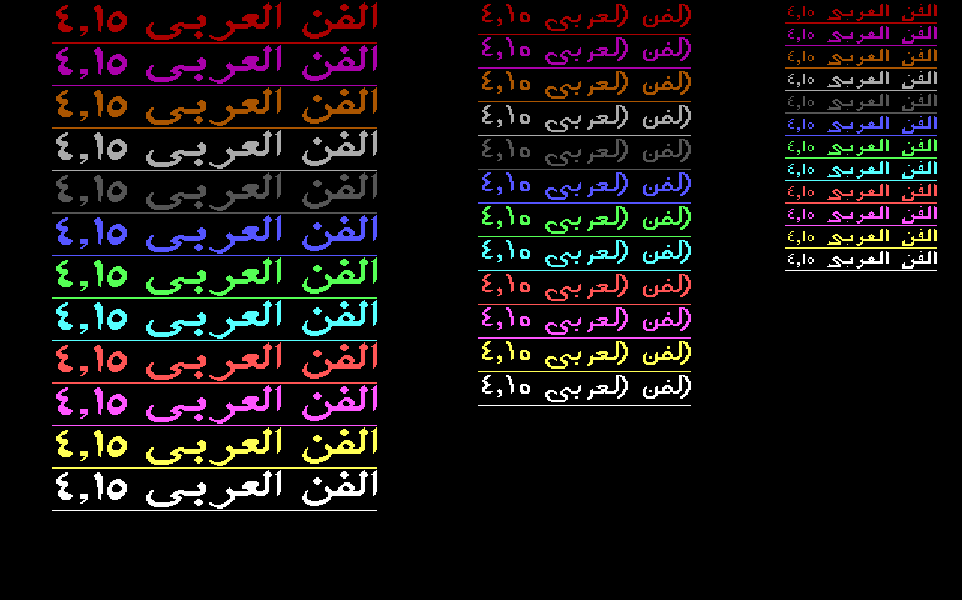
ARABART Demo
The showcase for his Arabic engine: one line of Arabic in four fonts and twelve colors, stretched, then all of it again in italic.
Cairo, 1993. Arabic comes to Windows.
Sakhr, in Cairo, made the first Arabic version of Windows 3.x. He joined in 1993 as a project leader. He built core parts of its Arabic office software, the programs people used to write, print and publish in Arabic.
Open each one to see what it did.
Read his whole careerSakhr Arabic Office
iClick me!
Open each icon to see what he built at Sakhr.
Arabic on paper, exactly as it looks on the screen. His printing core laid out each page right to left and sent it to the printer. Think of the print engine inside your browser, written for Arabic.
Arabic runs right to left and English left to right, and real documents mix both on one line. His text displayer drew each one in the right order, side by side. Every browser does this for you today. Then, someone had to write it.
One set of Arabic functions that any program could call, on Arabic Windows and on English Windows too. Like a shared package that every app imports, so no team has to write Arabic support twice.
The framework behind the installers for Sakhr’s multimedia titles: one tool that put each title on a PC and made it ready to run. The setup program of every app you install today does the same job.
Kanata, 1996. The networks of phone companies.
He moved to Canada and joined Newbridge Networks, which Alcatel bought in 2000. For ten years he was a senior designer and team leader there.
He was the architect of the CORBA interface of the 5620 Network Manager, the control room of a phone company’s network. Through that door, an operator’s own systems read alarms and inventory and order new connections. In today’s terms, it is the network’s public API.
Read the patent, explainedOne number for every port.
In 2005 he filed the idea that became US patent 7,603,377, granted in 2009, with Yasser Awad as first-named inventor. Each part of the network gets one 32-bit number, and the number spells out where the part sits.
Key
Everything in shelf 2 of node 5 has keys from 21,233,664 to 21,364,735. Sorted, they sit side by side, so the database finds the whole shelf in one read. A subnet works the same way: 10.1.0.0/16 holds every address that starts with 10.1.
Node 10 bits · shelf, slot, card 5 bits each · port 7 bits
Kanata, 2002. His own company.
In November 2002 he founded DinarSoft, and with his co-developer, Hosam Aly, built six apps for Pocket PC and Windows Mobile phones, the smartphones of the day. Reviewers called MemMaid “the Swiss Army Knife of PPC utilities”. Smartphone & Pocket PC magazine named HandySwitcher the best task manager in 2007 and again in 2008, and TapText the best Misc. Utility of 2007. His apps earned 22 nominations from 2003 to 2008.
Visit DinarSoftSolution ‘DinarSoft’ (6 projects)
iClick me!
Pick a project to run it on the Pocket PC.
Total Found:0 Bytes
Not scanned.
- Current Free Memory:
- 6.21 MB
- Reclaimed RAM:
- 0.00 MB
- New Free Memory:
- 6.21 MB
-
- sqmevent.exe
- \windows\enrollnot.exe
- \Windows\calupd.exe
- CALNOT.EXE
- clocknot.exe
-
- calnot.exe
When: Run at time
Argument: AppRunAtTime
Tuesday, July 10, 2007, 11:40:54 AM
-
-
- Ready2
-
- Software
-
-
- LicKey
- Language
- AdvancedMode
- EnabledItems
- SecureDelete
- ShowReport
- ShowProgress
- EnableSchedule
- ScheduleFreq
- ScheduleTime
- RRHibernate
- RRCompact
- RRCloseAll
- SilentReclaim
- SkinColor
- LastTab
- Pie3D
-
- HKEY_USERS
Internet Explorer
Type:Shortcut
Target:\Program Files\HandyLauncher\HandyLauncher.exe
-
- Windows : 58.86 MB
- Storage Card : 22.6 MB
- Program Files : 1.27 MB
- My Documents : 1.16 MB
- Documents and Settings : 748.0 KB
- Application Data : 1.28 KB
- ConnMgr : 158 Bytes
- Temp : 0 Bytes
Programs (6)Memory
Installed By: Windows Mobile
Target: \Windows\wmplayer.exe
Threads: 4
Database Usage
Every database on the device: its records, its size, and an explorer for its rows.
Extensions
Every file type and the program that opens it. Add, change or remove one.
Applications Cache
Move the caches of Pocket IE, Opera, NetFront, AvantGo, ring tones and mail to a card.
Information
The processor, the screen, the memory and the cards. On Windows Mobile 2003, a slider that splits RAM between files and programs.
DLL Optimizer
Move program DLLs off the main memory onto a card. The section on the DLL Optimizer shows how.
Startup Services
The services that start with the device. Stop one, start one, or switch it to manual.
Today Plugins
The Today screen plug-ins: switch them on and off, and put them in your order.
File Finder
Find files by name, with wild cards, and by size.
CAB Installer
Every CAB installer on the device, ready to install.
Installed Programs
Every installed program, sorted by name, date or size. Uninstall from here.
Card Tools
Format a card, scan it for errors, make it ready for a digital camera.
CPU Usage
How busy the processor is, program by program.
Running Processes
Every process with its threads, modules and memory. Compact one, or all.
About

MemMaid 2.3
www.dinarsoft.com
Copyrights Reserved 2004-2008 (c)
The trial period will expire after 15 day(s)
License Key
Settings
Every label in MemMaid comes from a table of 709 strings. A language is one small DLL with the same 709 strings, translated.
Look and Feel
Background:
Question
Are you sure you want to Soft-reset your device?
Tap to turn it back on.

MemMaid
The Best Maid for PocketPCs
DinarSoft’s flagship: it finds everything that fills a Pocket PC’s memory, clears it in one tap, then hands you the controls for the rest of the device.
- First
- 1.0, June 2003
- Latest
- 2.3, June 2008
- Price then
- $14.99 in 2006, $19.99 in 2008
- Runs on
- Pocket PC 2002 (version 1.73), Windows Mobile 2003, 5 and 6. Portrait, landscape and square screens
- Awards
- Finalist, 2005 to 2008Nominee, 2004
- Reviews
- 28 archived
- Today
- Free, with a free unlock key
Saturday, May 5, 2007
Tap here to set owner information
No unread messages
No tasks
No upcoming appointments
NNotes
Bubble Breaker is not responding because it is busy, waiting for a response from you, or has stopped running.
Do you want HandySwitcher to terminate the program anyway?

HandySwitcher
The Ultimate Task Manager
A task manager in the title bar: see every running app, switch with a tap, and close for real. The magazine’s best task manager of 2007 and of 2008.
- First
- 1.0, September 2003
- Latest
- 3.1, April 2008
- Price then
- $7.99 for 2.7, $9.99 for 3.x
- Runs on
- Pocket PC 2002, Windows Mobile 2003 and 5 (2.7); Windows Mobile 6 too (3.1). Portrait, landscape and square screens
- Awards
- Winner, 2007 and 2008Nominee, 2004 to 2006
- Reviews
- 9 archived
- Today
- Free, with a free unlock key

HandyMenu
Powerful System Access
One tap in the corner for the things you reach for most: power off, reset, screen capture, brightness, memory, rotation.
- First
- 1.0, July 2003
- Latest
- 3.7, June 2008
- Price then
- $5.99
- Runs on
- Pocket PC 2002, Windows Mobile 2003 and 5 (3.6); Windows Mobile 6 too (3.7). Portrait, landscape and square screens
- Awards
- Finalist, 2008Nominee, 2003 to 2007
- Reviews
- 4 archived
- Today
- Free, with a free unlock key
 10:47

The first menu is open, as its setup program filled it. Tap a shortcut to launch it.

HandyLauncher
The Seamless Launcher
Your own start menu in the corner of the screen, and every shortcut opens in the screen direction you chose for it.
- First
- 1.0, August 2003
- Latest
- 3.4, March 2006
- Price then
- $5.49
- Runs on
- Pocket PC 2002, Windows Mobile 2003 and 5. Portrait, landscape and square screens
- Awards
- Nominee, 2007 and 2008
- Today
- Free, with a free unlock key

TapText
More Text, Less Taps.
Saved text, typed into any app in two taps: signatures, replies, addresses, form answers and date stamps. Best Misc. Utility of 2007.
- First
- 1.0, March 2005
- Latest
- 1.3, February 2006
- Price then
- $9.99
- Runs on
- Pocket PC 2002, Windows Mobile 2003 and 5. Portrait, landscape and square screens
- Awards
- Winner, 2007Finalist, 2008Nominee, 2005 and 2006
- Reviews
- 7 archived
- Today
- Free, with a free unlock key
 8:03


HijriDate
What is Today
Today’s date in the Hijri calendar, in Arabic or English, right on the Pocket PC’s home screen.
- First
- 1.0, June 2003
- Latest
- 1.5, March 2005
- Price then
- $2.99
- Runs on
- Pocket PC 2002, Windows Mobile 2003 and 5
- Today
- Free, with a free unlock key
Still running.
He wrote these programs in Port Said with a few books and no internet. Today his son has put them back on a screen, so anyone can run them, type with his engine and see how he built them.